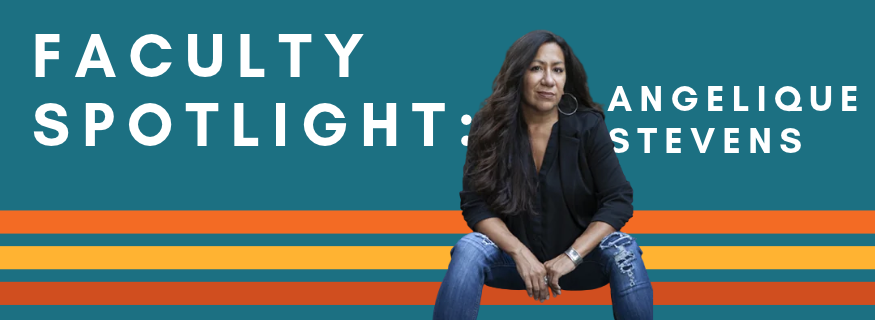
Angelique Stevens lives in Upstate New York, where she teaches creative writing, literature of genocide, and race literature. Her nonfiction has been published or is forthcoming in Granta, LitHub, The New England Review, and several anthologies. Her essay “Ghost Bread,” which won the Prism International Creative Nonfiction Contest, was chosen for Best American Essays 2022, and the very next year, her essay “Care Credit” made Best American Essays 2023. A graduate of the Book Project at Lighthouse, she holds an MFA in Creative Nonfiction from Bennington College and an MA from SUNY Brockport in Literature. She’s earned fellowships from Bennington, Hedgebrook, Bread Loaf, Tin House, Kenyon Review, Periplus, and Sewanee.
She’s currently writing a memoir about her experiences growing up in New York State. She finds her inspiration in wandering—being in places that push the boundaries of comfort, experience, knowledge, and hunger. She is represented by Ayesha Pande at Ayesha Pande Literary.
What kind of writing do you do? What led you here?
I’m working on a collection of essays about poverty, identity, and the myth of the American Dream. Both my identity and my creative practice are embedded in this act of mining lineage, in honoring those who have died before me, in making connections between our ancestral past and our contemporary obligations, in learning what to do with those stories, and in knowing that sometimes change needs a few generations. My writing practice, intertwined with years of scholarship as a professor of genocide literature, is deeply rooted in ideals of identity, human rights, and the literary representations that complicate our perceptions of humanity.
I came to Lighthouse through the two-year Book Project to work on my memoir, but then I wrote an essay called “Care Credit” about living with cockroaches and getting a $30,000 dental bill. After receiving emails and messages from people all over the country about it and their own experiences with poverty and cavities, I decided to write a proposal for a collection of essays that focus on different aspects of poverty and identity: health care, education, public assistance, our justice system, and even pop culture. Thanks to the guidance of Lighthouse and especially my mentor, Vauhini Vara, I sold my book to Simon & Schuster, and it should be out in the fall of 2027.
When you’re traveling, what non-essential items do you always bring along?
A few years ago, Alexander Chee curated a monthly subscription Boxwalla that I signed up for. One of the boxes included a set of tarot cards (Star Spinner Tarot and an inclusive set). I know nothing about tarot, but it’s a great way to get to know people at, say, a weeklong writing workshop or a writer’s residency or a conference. I also just love the way the cards look; they’re gorgeous. Also, I hear they can be a fabulous tool for fiction writers working on character and plot development. I almost always bring face masks and foot masks, because who doesn’t love a little pampering while away?
Got any news to share about upcoming projects, events, etc.?
I will be at both AWP and MLA this coming spring. I’ll also be teaching a few classes, one Advanced Nonfiction class at Lighthouse in January and a four-week non-fiction proposal writing class via Zoom. I have a Substack that is depressingly empty right now, but in the new year, I’ll be getting it up and going. It will be the best way to see any new events or projects. My book comes out next fall, in October/November.