
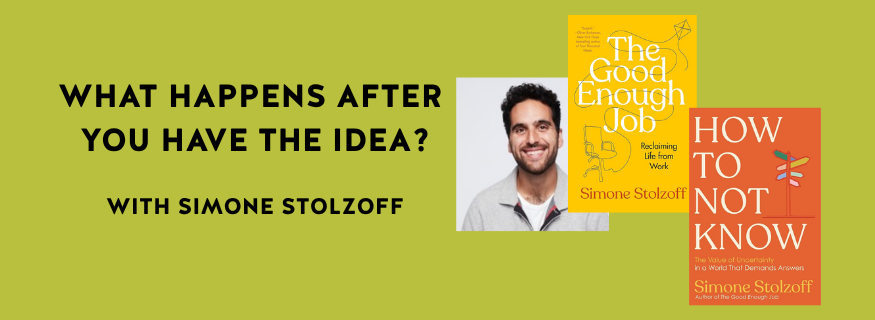
Book Project alum Simone Stolzoff advises nonfiction writers to build the book around the pages.
Every nonfiction book has a dangerous middle. Not the boring middle, exactly. The haunted one. The idea is there. The pages are coming. The obsession has teeth. The writer has the subject, the heat, maybe even the shadow of an argument.
And still, somehow, the book won’t behave and just become a freaking book already.
There may be notes, interviews, research, scenes, a half-built proposal, a draft that keeps changing shape, or a folder full of documents with names like “final_final_reallyfinal.docx.” The problem is not that the writer has nothing. The problem, it turns out, is that a book requires more than pages, and sometimes, the pages are the easier, or at least more intuitive, part.
At workshops and publishing panels, the same questions tend to surface: How much does platform matter? How many followers do I need? Do connections really make a difference? The answers vary by subject and genre, but in researched nonfiction, almost everyone agrees on some version of the same truth: the book is only part of the work.
Simone Stolzoff knows that part firsthand. His first book, The Good Enough Job, examined the danger of overidentifying with work. His new book, How to Not Know, came out in May 2026 and is “a lively case for taking chances and opening up to the world,” according to Publishers Weekly.
When I spoke with Stolzoff over Zoom from his Bay Area home in April, we didn’t spend much time mythologizing the writing life. We talked about the less glamorous labor: the practical architecture required to finish a book. Stolzoff came through Lighthouse’s Book Project from 2020 to 2022. His timeline, he said, “sort of lined up almost perfectly with the Book Project.” He landed with an idea but without having written the book. He spent the first six months working on a proposal, sold the book, then spent the next year and a half drafting it, turning in his first draft to his publisher the same month he graduated. The Book Project gave him “the structure, the accountability, the community, and the knowledge” to turn what he called his “amorphous writing” into a first book.
That experience is the foundation for his advice to nonfiction writers about the practical work around the work: build a project plan that makes finishing possible.
For Stolzoff, that scaffolding isn’t distinct from the creative life. It’s part of how the creative life survives.
“I think lots of people want to write books or have the ability to write books,” he said, “but it’s really a matter of: will you put in the time, and will you structure your life in such a way that you can actually get it done?”
That may sound obvious until you’re the person trying to do it. Nonfiction books—especially but not only reported, researched, proposal-driven nonfiction books—demand that writers move between numerous kinds of labor. There’s the writing of the book itself. There’s the business of finding an agent or publisher, the emotional work of staying with a project long enough to finish it, and, of course, the public-facing work of helping readers find it once it exists.
Stolzoff is candid about that last part. Most serious authors, he told me, spend nine months to a year thinking about marketing and promotion before their book comes out. He breaks book marketing into a few clear tasks: getting influential people to share the work, getting existing readers to read it, and giving those readers a way to share it with others. For his own first book, that meant understanding where his strengths were. He didn’t have a massive social media platform, but he did have media relationships, so he focused on press, essays, podcasts, and other platforms that could help the book reach readers.
That’s the kind of clarity he encourages writers to seek. Not a guarantee that every book will sell or the fantasy that the right color-coded spreadsheet can rescue a manuscript with no pulse. Stolzoff suggests you cultivate a way to see the book as a whole system, not just a stack of unruly pages.
As a writer myself, and as someone who first heard Stolzoff speak when I was in a Lighthouse class, I was especially drawn to how candidly he talks about the parts of the writing life that can feel embarrassing to name: ambition, strategy, platform, money, access, community, and the question underneath all of it: how to build a life around the work without letting the work eat the life.
The line of thinking is useful for nonfiction writers who are ready to think past the romance of “just writing”: writers who want to publish traditionally, turn a serious project into a career, and understand the strategy required to make a book part of an actual life.
A book doesn’t simply appear on the shelves and find its readers by osmosis. It has to be positioned, supported, shared, and given a fighting chance. Stolzoff talks about that machinery without making it sound cynical or soul-killing. A book-length project requires ambition, yes, but also patience, humility, community, and a tolerance for not knowing exactly how every step will unfold.
Writing a book the second time didn’t magically become easy, he said. The blank page returned. So did doubt. But the second time through, he had a better relationship with the bad days.
“There’s always gonna be certain days where you feel like, I am shit, this writing is shit,” he said. “But now that I’ve been through it once before, I can be like, oh yeah, I remember feeling that way before. And that can give you the conviction to keep going.”
He also had a clearer sense that writing a book is not the solitary myth we often pretend it is. “I do think having a writing community is the most underrated part of the book-writing process,” he said. The fantasy is Walden Pond: disappear, suffer nobly, emerge years later with a manuscript. But for Stolzoff, especially as a nonfiction writer, the work requires participation in the world: reading, researching, calling people, asking questions, talking with other writers, and staying in conversation.
Because finishing a nonfiction book is not just about having enough discipline to sit alone in a room. It is about knowing what kind of structure the book needs, what kind of support the writer needs, and what kind of plan can carry the project from private obsession to public work.
Or, to put it plainly: organization is an author’s best friend.
_____
Editor’s note:
Simone Stolzoff will be reading from How to Not Know at the Book Project showcase at Lit Fest. Come meet him and get a copy of his book on June 15, 4:00 PM MDT.
Also, Stolzoff is teaching a Two-Day Intensive: Finish the Nonfiction Book—Everything but the Pages. Open to all levels, but especially to those with book projects underway, the class takes place at Lit Fest, June 15–16, 1:00 to 4:00 PM MDT.