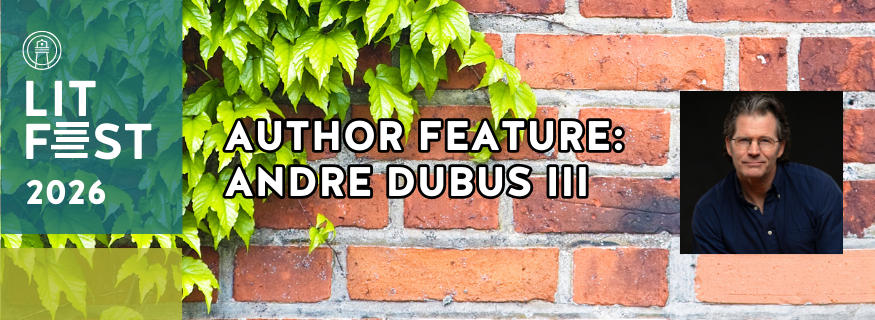
Andre Dubus III is an award-winning author who received a Guggenheim Fellowship, a National Magazine Award, three Pushcart Prizes, and an American Academy of Arts and Letters Award in Literature. Dubus has numerous books, including his memoir Townie, one of the best nonfiction books of 2011, and Ghost Dogs: On Killers and Kin, which earned him praise as “a literary treasure.”
Andre Dubus III is teaching an advanced workshop at Lit Fest in 2026, Excavation, focusing on bringing honesty to your character and letting them drive the story forward.
Learn a little about him in this Q&A before applying for his workshop.
What’s your teaching style?
I suppose it's the Socratic Method, where I have my writers sit in a circle, where I try to draw them out with questions about their own work, the work of their peers, as well as the work of more established writers. Though I'm rarely looking for "correct" answers, only their answers, which, of course, leads to deeper questions, only a few of which I may be able to answer myself...!
What's one tip you would give to another writer?
To trust her own curiosity about whatever characters and their particular situations she's writing about, to let her characters take her deeper into their story, which can only happen if one writes in an egoless state fueled by that above-mentioned curiosity, to see her characters as sacred beings who have chosen her and only her to bring them to life on the page, to honor them and their truth no matter what's going on in the literary marketplace, to never think of this marketplace when writing, EVER.
If you could only bring three books with you on a deserted island, which ones would you choose, and why?
A comprehensive anthology of contemporary poetry; the complete short stories of Ernest Hemingway; My Name Is Lucy Barton by Elizabeth Strout. I read poetry every day before I write, and I've done this for nearly 40 years. It's the finest writing we have, so much human life cut to its heartbreakingly beautiful essence, which inspires me as a writer and as a man. Hemingway's stories—they are as lean and essential as poems, and—contrary to his machismo myth—are suffused with pain and tenderness and a love of our brief time on earth. Lastly, this important novel by my dear friend, Elizabeth Strout, because it is filled with so much dazed compassion for we fallen creatures called men and women.
What is the best advice you ever got about your writing?
I've been given very little writing advice over the years, not because I don't need it but because, I think, I've rarely sought out teachers in my life and seem to prefer to go it alone. That said, when I was in my 20s, I was told by the writer Gordon Weaver that I needed to use more compound sentences, which I had stopped doing after a writer friend told me I was using too many of them. The only other advice I can remember came from my late writer friend, Kevin Harvey, who told me that I need more cosmic humor in my work. I agreed with him on this, but have come to believe that this is something that cannot be forced. Flannery O'Connor reminds us, "A writer's beliefs are not what she sees, but the light by which she sees."
Why do you think the literary arts are important?
In a time of screens, screens, and more screens, the literary arts could not be more important for they are the only "technology," my novelist and neuroscientist friend Erik Hoel tells us, that can penetrate the consciousness of another human being and carry it back to the reader. This act of creative communion opens the heart and not only makes us feel less alone, but also—studies have shown—more tolerant of others, more compassionate, less racist and homophobic, more merciful, on and on. So read, read, read, write, write, write....!
LitFest is an annual celebration of readers and writers that turns Denver into a literary hub every June for a Colorado summer full of workshops, readings, events, and more!