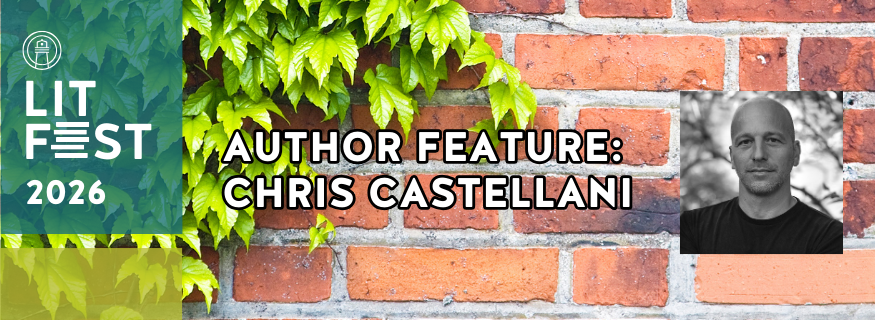
Chris Castellani is a highly accomplished author whose newest book, Last Seen came out on the same day of this blog post’s release! Castellani's other books include Leading Men, for which he received Fellowships from the Guggenheim Foundation, MacDowell, and the Massachusetts Cultural Council. Leading Men was published by Viking Penguin, and is currently being adapted for film by Peter Spears and Searchlight Pictures. Castellani is currently the Writer-in-Residence at Brandeis University, on the faculty and academic board of the Warren Wilson MFA program, and the faculty of the Bread Loaf Writers Conference. He has chaired the Writing Panel at YoungArts, aka the National Foundation for the Advancement of Artists since 2019.
Castellani is teaching an advanced workshop at Lit Fest in 2026, Who’s Telling Your Story?
Learn a little about him in this Q&A before applying for his workshop.
How did you get interested in writing?
When I was in the fifth grade, a local poet visited our class, gave a presentation on his work, and scribbled impromptu poems on the blackboard using random words that we kids called out at random. His imagination mesmerized me. At the time, I thought all writers were dead. I didn’t realize literature could happen now, in 1983, in a Catholic school in Delaware. I went home and wrote a long poem about a cardinal, substituting all the plain words for fancy ones from Roget’s Thesaurus. It began: “Paint me the sky an azure hue /and dot the horizon with the avians of twilight.” I showed it to my teacher, and she pinned it to the bulletin board. It was my first publication. I was hooked.
What’s your teaching style? What can people expect in your workshops?
What’s most important to me is to create an environment of mutual respect among the members of the workshop. I insist that we always respect the time, emotional labor, and sincere intention that went into each submission, even/especially if we have strong critical feelings about it. At no point in the discussion of someone’s work should we lose sight of the human being who produced it.
Workshop format is tailored to each writer’s preference: you can remain silent, participate in the conversation, ask specific questions, or none of the above. I see my job as that of a facilitator and synthesizer, though of course you won’t be able to stop me from offering my own highly subjective opinions that I hope you’ll challenge.
I’m Italian, so I talk with my hands a lot. I frequently spill my coffee. Sometimes I pace around the room because something you’ve written or said gets me worked up. This stuff really matters to me, and I don’t understand why you’re taking the workshop if it doesn’t matter to you.
How did you decide your workshop topic for this year's Lit Fest?
I’m continually struck by how (relatively) little thought many writers give to who’s narrating their stories, when, to me, it’s the most important decision you can make, and often the reason why the story is (or isn’t!) “working.” I wrote a book of craft essays called The Art of Perspective because I had an idea for a novel, but I couldn’t figure out who should tell it, or how, and since then I’ve been begging my students to be more strategic about the terms and conditions they set for their narrators.
What's the best advice you ever got about writing?
I thank my friend, the wonderful fiction writer and teacher Michelle Hoover, for sharing the famous Goethe quote with me many years ago: “Do not hurry. Do not rest.” For a novelist, this is crucial. It’s related to another great piece of advice I once got from a writing teacher: “Treat your project like a living thing – a plant, or a pet. If you don’t tend to it every day in some form or fashion, it will wither and die.”
You have a lot of experience with historical fiction. How do you find the balance between research and writing?
My mantra here is from another excellent writer and teacher, Thomas Mallon, who likes to say that, in the term historical fiction, “the noun always tr*mps the adjective.” In other words, our priority should be telling a good story, with complex characters who are products of their time and on some sort of compelling journey, not to show off all our cool research. I think “killing your darlings” is particularly hard for historical fiction writers because we fall madly in love with so many of the little facts and oddities we uncover, and we convince ourselves every single one belongs in the story. Too often, though, those little darlings just gum up the works.