It’s about connection, this thing we do—using language as a medium for discovery, to write the duende humming about in the deepest roots of human experience—in short, making art. We write to reach out to the voice inside that seeks meaning in life and death, and we write so others can share in these connections. What a welcome gift, then, to spend a November Poetry Fest weekend with other poets in a setting alive with themes of connection that twined throughout our two days together.
I find a special power in learning from others, the mind working to assimilate new ideas, creating networks of understanding. In addition, for me, much of the impact of an event like Poetry Fest is connecting in person. After all, we live in bodies designed to need the spark of presence in the flesh, the ambience of shared light and air, and the magic of becoming steeped in conversation (both direct and overheard!).
Many times throughout the weekend, I sat, pen in hand, buzzing with a tension between wanting to madly transcribe every word spoken and needing to be still and allow the often-extraordinary discussions to wash over me. Much of the time, I opted for the latter, and thus, the renditions below of remarks by brilliant people are my best attempt at paraphrase.
I don’t believe it’s too grand to think that writing and studying poetry brings us into a collective creative legacy that began before we were here and will go on without us when we are gone. Apropos of this, my weekend began in an encounter with the origins of lyric poetry through the wisdom of Homer, Ovid, and Rilke as shared by Dan Beachy-Quick in his workshop Lyric as Generative Loss. In excerpts from Hymn to Hermes, Metamorphoses, and Sonnets to Orpheus, it’s clear that lyric poets throughout time have sought to “understand the essence within the self that asks to be recognized. It is through this deep connection that poets can write the song of life in ways that connect us to a universal chorus.” (Dan Beachy-Quick1).
Poet Lee-Young Li once said (here at Lighthouse!) that poetry is the highest form of psychotherapy. But psychogeography? I’ve long understood the importance of place to connect a reader to a poem. Through writings by Jamaal May, Alice Notley, and Jennifer Foerster, Andrea Rexilius led us more deeply into the interplay of place and the psyche in the Psychogeography of Poems workshop. By challenging oneself to engage with place in different ways, we can change the mind’s pathway into a poem. In turn, “the geography of place can become a connection point for the landscape of the poem itself” (Andrea Rexilius2). All of which led me to think of Lighthouse, this place of community that we share, the geography of which includes creativity, education, and provocative discourse.
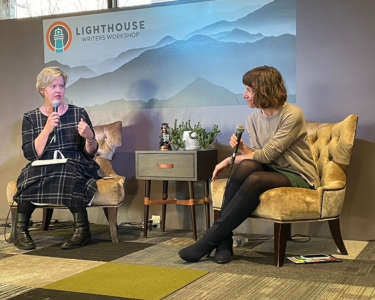 Saturday’s reading and conversation between Heather Christle and Elizabeth Robinson was another highlight. What fun to watch two poets who did not know one another personally before the festival, who probably knew little of each other’s theory of self, politics, and spiritual leanings. Yet, the connection between them vibrated throughout the room as they shared, with humor and passion, a common bond in the art and process of writing.
And if ever we’ve needed common bonds, literary or otherwise, it is now. We are reminded of the importance of connection in the very tools we use to write. Doesn’t metaphor itself lead us to recognize sameness and interconnectedness, even within difference? From poet John Brehm, “When we encounter the stunning rightness of a metaphor in a poem, the mind lights up: we suddenly see the hidden likeness, the deep existential connection, in apparently dissimilar things, and the puzzle pieces click into place.”3
Two months have passed, and I still buzz from a weekend with people of similar mind, artistic culture, and sense of wonderment. For me, the shared study of poetry is a reminder that in living with essential human realities like impermanence, beauty, loss, love, despair, rage…we are not alone. From Elizabeth Robinson and Matthew Zapruder during the Church of Poetry Panel, “When we are with each other in poetry, we are in sanctuary, a state of grace. We are here to protect each other’s imagination, here to ‘be’ in a way that departs from the usual.”4
Well, Hallelujah to that!
I look forward to the upcoming Lighthouse Love Fest, another opportunity to gather as poets and writers across genres. Another opportunity to again celebrate, in community and artistic connection, this thing we do.
Weekend Fests
Join Lighthouse for other weekend Fests throughout the year, focusing on different genres, topics, and communities, to foster your own connections with the literary arts and other writers.
Citations
1 Paraphrased “Lyric as Generative Loss,” Dan Beachy-Quick. Lighthouse Poetry Fest 2025
2 Paraphrased from “The Psychogeography of Poems,” Andrea Rexiliius. Lighthouse Poetry Fest 2025.
3 Paraphrased from comments by Elizabeth Robinson and Matthew Zapruder in the panel discussion “The Church of Poetry,” Lighthouse Poetry Fest 2025
4 Excerpted from “Not Same, Not Different: Metaphor as a Vehicle for Experiencing Non-duality,” John Brehm.