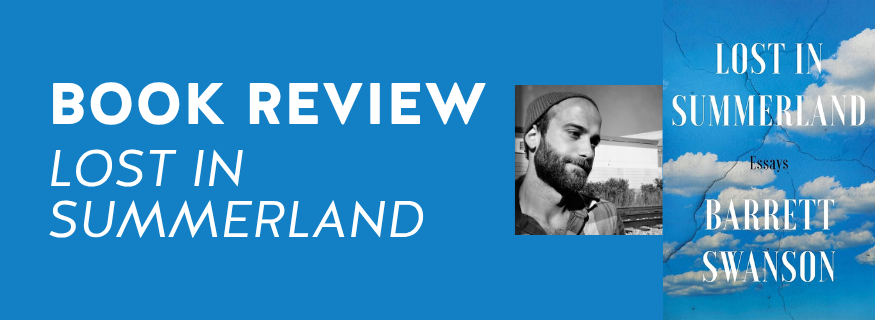
Lighthouse instructor Barret Swanson’s debut book of essays, Lost in Summerland, was published in May of 2021, and its proposed questions about the American Dream continue to be timely today. The Los Angeles Review of Books proclaimed, "The 14 essays of Lost in Summerland range over the continental United States, but their travelogue is spiritual...Swanson’s book cuts deep with a shard of mirror, and I’m trying not to bleed."
This series of essays explores what it means to be an American in today’s socio-political climate. The author himself will be at Lighthouse on May 8 to discuss this topic at American Dream, Revised.
Book Project participant Jenny Catlin read the book a few years later (2026), and found the same rawness of the work as relevant today, if not more so, as it was when Swanson first wrote it. Hear her thoughts on reading this book of essays:
The Country Is Haunted, and Barrett Swanson Knows It
Barrett Swanson’s Lost in Summerland made me feel like I should have paid more attention in at least three different college classes, and I was a nerd. There were words I had to look up. References I had to chase. Sentences I had to read twice, not because they were showing off, but because they were doing something dense and exact and alive.
I love that in a book. I love prose that assumes I can keep up, or at least that I’m willing to try. But it’s hard to pull off without being either boring or condescending. Swanson is neither. I suspect the prose here mirrors the cadence of a casual conversation with Swanson pretty closely, which is to say the density feels organic and never overwritten.
Lost in Summerland, Swanson’s debut essay collection, moves through belief, grief, American loneliness, spiritual hunger, masculinity, war, climate dread, capitalism and conspiracy thinking, but its deepest subject is what people reach for when the old explanations stop making sense. The expanse could easily be too broad, but here, it feels warranted. Swanson isn’t tossing subjects at the wall. He’s circling the same haunted question from different angles: What do people do when the world they’ve been promised turns out not to exist?
The book’s title essay follows Swanson and his brother to Lily Dale, the spiritualist community in New York known for its mediums and psychics. Swanson knows there’s an easy laugh inside the setup, but he doesn’t write from above the room. He lets the weirdness stay weird without making the people inside it small.
One of the reasons I love this book is that Swanson understands how cheap contempt can be. He is funny, and devastatingly sharp, but he doesn’t write about people’s longings as if he’s above them, and he never mistakes longing for stupidity. He knows people don’t go looking for ghosts, gurus, brotherhood, reinvention, prophecy, wellness, violence or transcendence because everything is fine. They go because something has cracked. Because something never held. Because the story they were handed can’t explain the life they still have to live.
I know this impulse better than I wish I did. Years ago, I went to Naropa for a degree in ecopsychology and did the whole earnest curriculum of seeking: eye-gazing, fasting, solo camping, sitting in circles with people trying very hard to become less ruined by the world. Part of me knew, even then, how ridiculous some of it could look. But another part of me was there for the same reason Swanson’s subjects go toward ghosts, gurus, prophecy, brotherhood, wellness or whatever door looks half-open. I wasn’t above it. I was broken, and I wanted some story large enough to hold the pieces.
That’s where the book gets its rawness. Swanson’s essays are reported, but they don’t feel sealed off from him. He’s present, but not in the exhausting way some essayists are present, where every subject eventually gets dragged back to the self as the only room in the house. His “I” works more like a nerve ending. It registers pressure. It lets the outside world in.
I kept thinking about that while reading: how hard it is to write essays that are both intelligent and vulnerable without making either quality feel like a performance. Swanson pulls it off because he’s not interested in tidying up the mess. He doesn’t explain America into a neat little thesis. He lets the weirdness stay weird. He lets grief stay grief. He lets delusion remain both ridiculous and human. He is in these pages not because the stories are about him but because he is in the stories. For nonfiction writers, this distinction is tricky to identify this sharply.
The book is also topical in a way that doesn’t feel trapped in its moment. Published in 2021, Lost in Summerland clearly belongs to the post-2016, post-truth, end-times wellness, conspiracy-soaked version of America. But reading it now, it doesn’t feel like a time capsule. It feels like Swanson was paying attention to a deeper weather system. The paranoia, the spiritual desperation, the moral exhaustion, the male panic, the ecological dread: none of that has gone anywhere, unfortunately. If anything, the book feels more accurate now.
And the prose. Goodness, the prose.
Swanson writes lushly, but not softly. His sentences have muscle and voltage. They move with the energy of someone thinking hard and refusing to sand the thought down for digestibility. This isn’t a book built for skimming, and I mean that as praise. The language asks something of the reader. Sometimes it asks you to slow down. Sometimes it asks you to sit with a word you don’t know. Sometimes it asks you to trust that the sentence knows where it’s going before you do.
That kind of writing can become precious fast. Here, it rarely does, because the stakes are real. Swanson isn’t decorating the page. He’s trying to be precise about experiences and systems that resist precision: grief, belief, masculinity, class, violence, despair, the eerie American hunger to turn every wound into a brand, a lesson, a lifestyle or a revelation.
There were moments when I felt him almost pushing language as far as it could go because ordinary language had already failed. That feels right for this book. If you’re writing about a country where so much public language has been flattened, corrupted, politicized, monetized or emptied out, then the prose has to fight back. It has to find better words. Sometimes harder words. Sometimes stranger ones. The American air is so overstuffed with words, if a writer can pull it off, and this one does, reaching for the more academic language is a kind of release valve.
What I admire most, though, is the book’s tonal control. Swanson can move from intellectual analysis to emotional exposure without making either feel abrupt. He can write about big cultural forces without losing sight of the body in the room. His essays understand that ideology isn’t abstract when it’s living in someone’s house, someone’s marriage, someone’s memory, someone’s nervous system.
That’s part of what makes Lost in Summerland such a strong book for writers to study. It refuses the fake divide between personal essay and reported essay. Swanson doesn’t choose between scene and thought, research and feeling, the self and the world. He braids them. He lets each one complicate the other. There’s a delightful quality to this work that feels a bit like New Journalism—with a heartbeat.
The result is a collection that feels intellectually ambitious without being bloodless. It’s smart as hell, but it’s not cold. It’s funny, but not glib. It’s skeptical, but not smug. It’s sad, but not deadened by sadness. Again and again, Swanson writes toward people who are reaching for meaning in places that might not save them: spiritualist communities, military mythologies, football fields, disaster-preparedness fantasies, farms, rituals, bodies, landscapes, old national stories that keep failing and still won’t quite die.
The title keeps opening up the longer you sit with it. Summerland is, in spiritualist belief, a kind of afterlife. But in Swanson’s hands, it also starts to feel like a name for America’s weird suspended state: half apocalypse, half vacation; half belief, half scam; half grief, half performance. Everyone wants proof that the dead are still speaking. Everyone wants proof that the country can still be saved. Everyone wants proof that the self can still be remade before the disaster fully arrives.
Swanson is too honest to hand over that comfort cleanly. But he’s not nihilistic, either, which might be the book’s deepest grace. Lost in Summerland looks directly at loneliness, fraudulence, male damage, ecological fear and spiritual desperation without acting as if those are the only truths available. It finds tenderness without getting sentimental. It knows people can be wrong, even dangerously wrong, and still be reaching for something real.
That’s why I loved it. Not because it made me feel smart. Sometimes it made me feel wildly underqualified. But it made me want to read better, think harder and stay longer with the uncomfortable thing before turning it into an argument.
For Lighthouse readers, especially anyone interested in what the essay can hold, this collection is worth spending time with. It’s reported and personal, topical and strange, raw and carefully made. It’s a book about America, yes, but also about the stories we reach for when America fails as an explanation.
The country is haunted. Barrett Swanson knows it. More importantly, he knows the haunting isn’t the whole story.
Meet the Author
Jenny Catlin has seen much success as a Pushcart Prize winner, a notable mention for Best American Essays, and as a writer for The Athletic, The Gettysburg Review, Willow Springs, and Horror-Sleaze-Trash, among other publications. As an educator, she has taught incarcerated people, college freshmen, and adults with intellectual disabilities. Jenny has ghostwritten thousands of pages of bureaucratic policy documents.