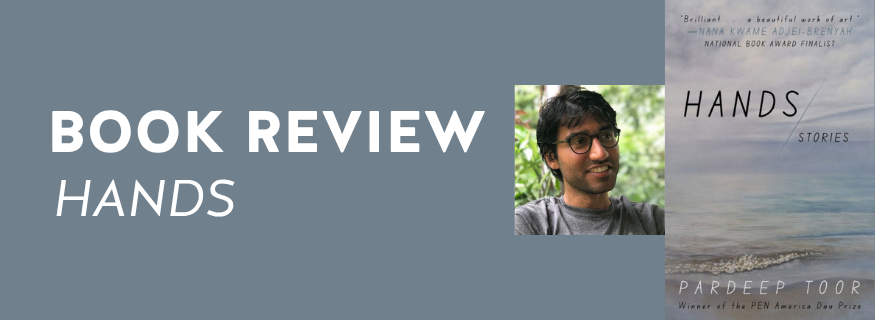
What does the concept of the “American Dream” mean to you? How has this perception changed over time? What if you can’t achieve the American Dream, or there wasn’t one to begin with? This question comes up in Lighthouse instructor Pardeep Toor’s debut novel Hands, which came out in April 2026. The story follows Hans, an immigrant to the USA from India in pursuit of the American Dream, with twists and challenges in his path.
I read Pardeep Toor’s Hands not as a sealed object dropped from the sky, but as a part of a living conversation. Art of any kind is always talking to other art; no work is a monolith. This is common sense to any writer, but being part of Lighthouse has made me more attentive to the conversation. I’ve found myself becoming exponentially more conscious of the community on the page.
A book is never just there, just written. It’s a residue of the obsessions, drafts, arguments, good and bad feedback, risks, bad habits sharpened into voice and the horrifying wager every writer makes when they decide the thing they can't stop circling might be the thing worth writing, the thing that insists on being written.
In my MFA program, I had a professor refer to it as the donut hole of shame, and while I can’t remember how that metaphor actually worked, I still like it.
All that to say, Hands feels very much like that kind of book. It has the high-impact voltage of a writer who, perhaps against his own better judgment, grabbed the live wire and now refuses to let go.
Toor’s debut collection follows Hans, an Indian immigrant in Michigan, across six linked stories that mostly behave like a novel but show the advantages of a collection if you look closely enough. I think the way the collection allows us to time travel with Hans is its greatest structural strength. The narrative has continuity, damage, and recurrence, but every story/chapter stands on its own two feet just fine. “Taxi,” which won the PEN/Robert J. Dau Short Story Prize for Emerging Writers in 2021, is complete by itself: strange, funny, ugly, sad, and meticulously pressurized. But read in sequence, the stories accumulate into something larger, the record of one man’s long, failed edification in America.
I don’t mean failed because he doesn’t try, doesn't work, shuns American assimilation. He tries, with an almost heartbreaking stubbornness to find the correct path to legitimacy. The opening story, "Gatsby," introduces us to a teenage Hans shortly before he leaves school to drive a taxi full time with his cousin. He’s one of two Indian students at a Michigan high school, learning the brutal social physics of race, violence and masculinity. He’s trying to understand the rules, but the rules keep changing because they were never built for him in the first place. By “Dinner Party,” he’s trying to enter the polished, assimilated world of his girlfriend Neelam’s family, where shared ethnicity doesn’t mean shared class, shared language, shared memory or even shared mercy. By “The Astrologer,” Hans is older, lonelier and more damaged, but not wiser—at least not in any clean or satisfying way.
Toor doesn’t make us like Hans. I’m not sure he’s even inviting us to, and I’d argue Hans’s dislikeability is the collection's greatest achievement.
Hans can be funny. Hans can be lonely. Hans can be disgusting. Sometimes he is all three in the same paragraph. Toor doesn’t launder him through suffering. He doesn’t pretend injury makes a person noble. In fact, if anything, Toor is shining a light on the unfortunate reality that often ugliness makes us ugly as well.
Hands is a book deeply aware of racism, immigrant labor, class pressure, and cultural isolation, but it’s not interested in making oppression into sainthood. Hans is wounded, yes. He’s also selfish, evasive, horny, cruel, absurd, and often wrong. I trusted the book because Hans is human, and I didn’t particularly like him.
I’ve spent a lot of time in workshops, Lighthouse and otherwise, talking about likeability. How important is the likeable narrator or protagonist? For some people, it matters, they need a certain likeability to buy into the narrative. I’m not one of those readers. I love a vile protagonist: The Underground Man, Dorian Grey, etc. What matters more than charm is whether a character is rendered with enough pressure and contradiction to become unavoidable. Hans isn’t easy to love, and thank goodness for that. Literature is not a customer service desk. What Toor does is both harder and more useful: he keeps us close enough to Hans to understand him without ever being asked to excuse him.
Writers who explore the less-than-charismatic protagonist are going to face more challenges than those who give us someone loveable. You have to be razor sharp with your word choices to make a reader see themselves in callous, deeply flawed characters. Which is to say, you better be a damn good writer. Lucky for us, Pardeep Toor is. His style isn’t trying to be pretty in the decorative sense. The sentences are often short, blunt and literal, which makes the moments of tenderness hit harder. Neelam putting real estate equations on Post-it notes around Hans’s apartment. Hans noticing a house that “made sense” because Neelam came from it. A body in water, briefly weightless. A mother’s hand, a stranger’s touch, a cigarette, a steering wheel, a prayer ritual, a slap.
The title keeps opening up the longer you sit with it. Hands in this book work, steal, drive, smoke, bless, grope, hold, strike and burn. They are how people survive and how they harm each other. They are also how they try, badly and sometimes beautifully, to love.
That’s where the collection surprised me. I expected the sharpness. I expected the immigrant dislocation, the class tension, the ugly comedy of American aspiration. What I didn’t expect was how much tenderness could survive inside the wreckage. Not softness. Tenderness. There’s a difference. Softness asks the reader to look away from the worst of a person. Tenderness looks directly at the worst and still notices the human body underneath it.
The Michigan setting is also wonderfully specific. This isn’t vague America. It’s rural schools, taxis, lake houses, pizzerias, bad apartments, frozen roads, bars, basements and strip-mall spiritual economies. The Midwest presses on every page. Snow matters. Roads matter. The lake matters. So do tips, gas prices, cheap wine, smoke, uniforms, delivery shifts, dirty cars and the small humiliations of being read incorrectly over and over again. Hans is always trying to read the room after the room has already misread him.
That feels especially sharp in the stories about class inside immigrant communities. “Dinner Party” might be the story I kept returning to most. The dinner itself is almost unbearably tense because nobody is only saying what they’re saying. Neelam’s family has made it into a version of American comfort Hans can recognize but not enter. Her father’s contempt is not simply racism turned inward, though it’s probably partly that. It’s class panic. It’s assimilation as a gated community. It’s the old immigrant horror of being reminded of what you came from by someone who has not yet learned how to hide it. This is the grotesque fun house mirror reflection of what the “American Dream” asks of everyone trapped inside it and anyone wishing to enter.
That’s one of the places where Hands feels particularly alive to me as a Lighthouse-adjacent book, or at least as a book I want to talk about in that community. Lighthouse at its best is full of writers thinking seriously about inheritance: what we keep, what we revise, what we lie about, what we translate badly, what we make art from because there’s no other honest place to put it. Toor’s collection lives inside those questions without turning them into slogans. The book isn’t asking, “What does it mean to belong?” in some tidy MFA brochure way. It’s asking what happens when belonging keeps arriving with a bill attached.
The collection isn’t flawless. There are moments when Hans’s grotesquerie risks becoming the dominant engine of the story, when his sexual fixation and bodily strangeness crowd the frame so much that I wanted more room for some of the other textures of his mind. At times, the book’s narrowness can feel punishing. But I also think that narrowness is part of the design. Hans’s life is narrow. His options are narrow. His imagination, even when it reaches for real estate, romance, money or reinvention, keeps dragging him back to the same hunger.
And honestly, I’d rather read a book that risks too much ugliness than one that sands itself down into respectability.
What saves Hands from bleakness is its precision. Toor has a terrific ear for the moment people reveal themselves while thinking they’re hiding. He understands bad advice, wounded pride, the comedy of ambition, the menace of politeness and the weird intimacy of work. He also understands that the American Dream is often not one dream at all, but a series of errands: drive here, deliver this, pass this test, make this money, learn this language, buy this house, become this kind of man, don’t look too hard, don’t want too much, don’t remind anyone of where they came from.
I kept thinking about how much writing like this depends on nerve. Not confession. Not shock. Nerve. The willingness to let a character be unflattering. The willingness to let humor and harm occupy the same room. The willingness to trust that a linked collection doesn’t have to behave like a tidy novel to create a full life on the page.
Hands is a debut, but it doesn’t read like a book begging to be taken seriously. It already takes itself seriously enough to be strange. That’s the better thing. It has bite, sorrow, grime and some startlingly loving language tucked inside the damage. It reads like standalone stories and like one ongoing argument with fate, work, class, family, God, women, whiteness, America and the self.
I finished it thinking less about whether Hans changes than whether change is always the right question. Some lives don’t arc. They circle. They idle outside the house. They run the meter. They make another delivery. They put both hands on the wheel and pretend, for another block, that they know where they’re going.
Learn from Pardeep Toor at Lighthouse! One of his upcoming workshops includes Is My Character An Asshole? (June 13 from 1:30 to 3:30 PM MST).
Meet the Author
Jenny Catlin has seen much success as a Pushcart Prize winner, a notable mention for Best American Essays, and as a writer for The Athletic, The Gettysburg Review, Willow Springs, and Horror-Sleaze-Trash, among other publications. As an educator, she has taught incarcerated people, college freshmen, and adults with intellectual disabilities. Jenny has ghostwritten thousands of pages of bureaucratic policy documents.