Claire Jia on Wanting, Screenwriting, and Turning Longing Into Plot
A good friend recently said: good art guts you and pours lemon juice on your insides. And he’s right. That’s why great writers can circle the same few subjects and make them fresh over and over again. Yearning is both trope and archetype, and it’s nothing revolutionary for yearning to act as the propelling force in a plot. But the beauty of these base human needs and instincts is that, in the right hands, they’re timeless and endlessly reinvent-able. Enter novelist Claire Jia, who’s naturally built for the subject of wanting.
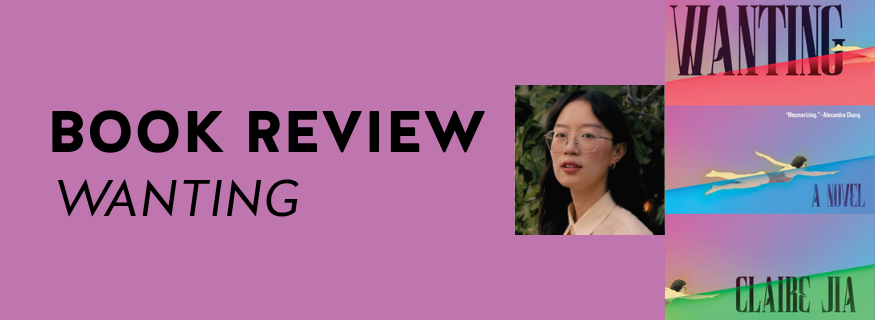
In her debut novel, Wanting (Tin House Books), Jia builds a whole deranged ecosystem of want: romantic, professional, financial, architectural, creative. Wanting treats desire as a corporeal experience, at once degrading and rewarding. Rewarding because as long as we want, we have a future.
The story follows Ye Lian, who is, by all metrics, building a proper life in Beijing. She has a serious and successful boyfriend, the kind of future that all but guarantees stability; she has a socially acceptable career; she’s shopping for posh condos. Lian is content, and content is enough. Or it should be, she tells herself.
But then American social media influencer Luo Wenyu’s wedding invite shows up, transforming her in Lian’s mind from a mythical, if slightly repulsive, online spectacle into something much harder to ignore.
Wenyu and Lian were childhood best friends, but Wenyu’s return from the United States brings more than old intimacy back into Lian’s life. She arrives with an American fiancé and plans for a dream home ostentatious enough to make everyone else’s successes feel insignificant.
The structure of the story is familiar: one person stayed and another left. The way Jia plays with that structure is intoxicating and worth lingering over, because this could’ve easily become a tidy little book about envy or being grateful for what you have, and it’s anything but.
In Wanting, desire isn’t a lesson or a moral failure. It’s pressure.
During a virtual conversation across time zones, Jia described her characters as people at the age when achievement starts to curdle into obligation. The job, the partner, the apartment, the European vacation: all the markers that once looked like confirmation of accomplishment begin to feel frightening and unresolved. Did I choose this because I wanted it, or because I was good at wanting what I was supposed to want?
This is a familiar late-coming-of-age tension, but the narrative isn’t just asking what might’ve happened if Lian had chosen differently. It’s asking whether she ever stopped long enough to recognize longing as something separate from achievement. Jia connected that tension to her own life. She studied political science and once imagined becoming a lawyer or diplomat before realizing she was pursuing that path partly because it felt like something she should do. She eventually turned toward film, television and, lucky for us, fiction. Lian, she said, is in some ways the version of herself who had not made that more dangerous choice. Like so many of us, Lian is faced with the stark possibility that her choices were a rote response to obligation and the clean, respectable story of a life going according to plan.
Asked what screenwriting in particular gave the novel, she pointed to structure. “Structure is king in screenwriting,” she said. Fiction let her sink into voice, character and setting; screenwriting taught her how to turn atmosphere into action.
You can feel that screenwriter’s sense of motion all through Wanting. This is a deeply interior book, but it’s not inert. It moves. Jia explained that she wrote each chapter like an episode of television, with its own rise, fall, event and shift in character. Like a single episode, each chapter had to actually do something. Every scene had to create a new problem, choice or consequence.
She mentioned Dan Harmon’s story circles almost offhandedly, as if it were already part of the shared writerly scripture, saying she used them to outline the whole book, the kind of practical craft hint that makes every writer in the room reach for a pen.
For writers, Jia’s craft thinking may be as useful as the book itself is absorbing. One of Jia’s Lit Fest classes works in that spirit, asking what writers can learn from film and television without any dogma about how a book must behave like a screenplay. Three-act structure, act breaks, characters who change from beginning to end: not commandments, but tools for finding where a story holds pressure and where it goes slack.
Jia’s approach also has a useful lack of dogma. She’s interested in screenwriting structures, but not as commandments. She talked about looking at story circles, Save the Cat beats, and traditional feature formats, then testing whether they help a writer find the story they want. Maybe they do. Maybe they don’t. A structure can clarify a book without domesticating it.
So many of us struggle with how to keep the beautiful skin of a story while also giving it enough bones to stand upright.
Jia’s refreshingly direct about the difficulty of turning atmosphere into story. A lot of writers can make a mood. Many can write a beautiful paragraph. Fewer can make a chapter move a character from one state to another, or create a new problem, choice or consequence. Jia’s screenwriting background gives her a practical language for that problem. Structure, in her hands, is not a cage for literary fiction. It is a way of making pressure legible.
An example Jia turns to for structure is via Ruben Östlund’s Triangle of Sadness, which she uses to teach writers about the three-part story and triptych structure. Her own book, Jia notes, is also a triptych, so this isn’t theory floating above the work. It’s craft drawn from the same machinery that shaped the novel.
That distinction feels important for fiction writers who know they have a project, or at least a project-shaped idea, but can’t yet figure out how to make it move. Jia spent ten years writing Wanting, and she’s frank about the difficulty of that process. Near the end, she said, she wasn’t sure she could ever write another book. One of the surprises of publication has been finding her way back to the desire to do it again.
Wanting’s answer is not some inspirational poster decrying that you follow your bliss. The book understands longing as both beauty and lack. Jia said she hoped this state of want would function not only as a mood, but as a narrative force: something people bend toward across a whole life.
Jia told me she believes we’re all, in some way, arcing toward something. I tend to agree.
Lian has many of the things a person is supposed to want: stability, a future, a partner who’ll show up with soup. The problem isn’t that these things are worthless. The problem is that they’re not enough to quiet the part of her still reaching for another life. That lack makes her, in Jia’s phrase, “poke the bear.”
Despite its sharpness, though, Wanting is remarkably tender. For a book built around comparison and perceived lack, it never slips into cruelty. Jia explained that tried not to assign judgment to any character. That restraint lets the narrative take envy seriously. Everyone compares themselves to other people. Everyone has had the ugly little moment of looking at someone else’s apparent success and realizing the feeling is not admiration, exactly, or not only admiration.
Jia doesn’t pretend this impulse is pretty, but she also doesn’t pretend it’s rare.
Instead, Wanting asks what envy might be trying to tell us. Sometimes it’s pettiness. But just as often, it’s grief or information. Sometimes it points toward a desire so old or inconvenient that we mistake it for resentment.
That experience echoes one of the novel’s central concerns: the gap between the fantasy of arrival and the reality of living after arrival. A book deal doesn’t solve every problem. Jia said as much directly. But it opens doors, brings unexpected joys and creates the strange, durable pleasure of seeing your book on a shelf or hearing that it mattered to someone.
For writers, especially those somewhere in the long private pilgrimage toward a first book, that may be one of the most generous parts of Jia’s visit. She’s not selling publication as a magic cure. She’s talking about the work as something that can keep you company before anyone else knows what it is. “Having the dream of this novel is what kept me going the last decade,” she said.
That’s the trick of the title. Wanting means desire, yes. But it also means lack. To want is to admit absence. To want is to notice the distance between the life you have and the life that keeps flashing at the edge of your vision.
Jia’s debut lives in that distance: sharp, restless, emotionally generous and structurally alive, a novel about what happens when a respectable life can no longer protect a person from what she wants. And a reminder that longing, in a deft writer’s hands, can become an engine to propel any story.
Editor’s Notes
Claire Jia is coming to Lighthouse for Lit Fest 2026! She has written on TV shows (Awkwafina is Nora from Queens, Fresh Off the Boat) and co-wrote the 2024 Peabody Award-winning video game We Are OFK. Her debut novel, Wanting, came out summer 2025.
She is teaching Hook, Line, and Sinker: Exploring Form Via Ruben Ostlund’s Triangle of Sadness and That's Cinema: Applying Screenwriting Techniques to Novel Writing at Lit Fest. She will also share her insights on life as a working writer through a panel discussion and you might even catch her reading at Open Mic Night.