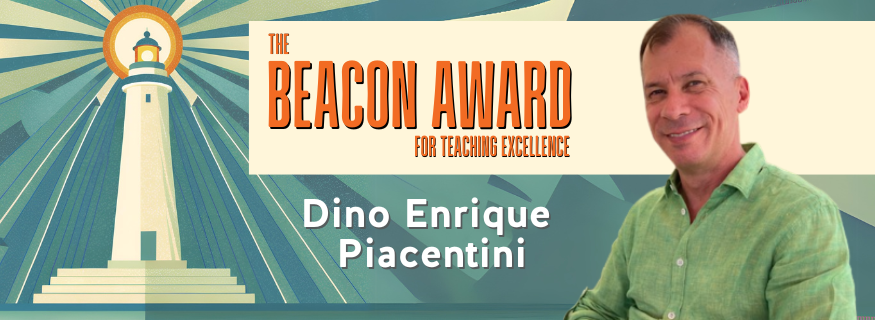
We’re pleased to announce Dino Enrique Piacentini as the winner of the 2025 Beacon Award for Excellence in Teaching.
Dino Enrique Piacentini grew up in Los Angeles, lived in San Francisco for twenty years, and has also, at various times, set down stakes in Houston, Oaxaca, Champaign, and Prague. His debut novel, Invasion of the Daffodils, about a Mexican-American family living on an island off the coast of California during the Korean War, was released by Astrophil Press in 2024. His short fiction has been published in such places as One Story, Gulf Coast, Pembroke, The Masters Review, and The Massachusetts Review. He was a collaborating writer for the Aura Contemporary Ensemble’s Words and Music concert and served as Fiction Editor at Gulf Coast: A Journal of Literature and Fine Arts. He has taught creative writing at University of Illinois, Urbana-Champaign; the University of Houston; the Boldface Emerging Writers Conference; and Inprint Houston. Before becoming a writer, he worked as an arts administrator at The Mexican Museum, Yerba Buena Center for the Arts, Asian Art Museum, and Galería de la Raza. Currently, he lives in Denver, where he teaches creative writing at Lighthouse Writers Workshop and the University of Denver.
The Beacon Award was established over fifteen years ago by writers in our community to honor a Lighthouse faculty member for teaching excellence, commitment to students, and dedication to the craft of writing. This annual celebration is made all the more special by the fact that this is a community-driven award—the nominations, deliberations, and ultimate decisions are made by the community, not Lighthouse staff.
We’ll be officially celebrating Dino at our Holiday Party on December 12, but in the meantime, we’ve solicited a few testimonials from his fans below. Congratulations, Dino!
Testimonials
Dino is the ideal instructor because he effortlessly strikes the difficult balance between being your fellow writer and also your wise teacher. He speaks with knowledge, passion, experience, and kindness and without a hint of ego. I have found that some working writers treat their teaching as a painful obligation, but Dino is always decorous and authentic. He listens to his students’ observations intently and with great respect, encouraging us and helping us to articulate and build on our ideas.
The time and effort Dino commits to developing classes and teaching them deserves commendation because he clearly takes his role as a teacher very seriously. He understands and honors his responsibilities and his duty to his students. He is devoted to the reading of literature and to the writing of it—not just to his own work, but equally to that of his students. He really does live and breathe fiction, and he walks the walk and talks the talk.
Dino reads your manuscripts with great care and attention to your writing, and does not try to impose his own leanings or opinions upon it. I imagine Dino holding a stethoscope up to my pages, closing his eyes and listening to the manuscript’s heartbeat. His goal is always to understand what your story is and what it wants to be, and to then help it to become the best version of itself. Dino is your manuscript’s biggest fan, and I believe it would not even occur to him that any other attitude could be possible.
Dino’s Lighthouse classes are enjoyable and edifying in so many ways, but they are foremost analytical and practical, and geared toward the service of improving our own manuscripts and herein to contributing to America’s formidable canon. Dino worships at the altar of art itself, and his true devotion to it is rare and even childlike in its tenacity and fidelity. It is not an exaggeration to say that if not for Dino, I would have given up on writing altogether. Thank you, Dino. Thank you, thank you, thank you. You are truly a beacon of guiding light.
—Elizabeth Davies (4-Week: Omniscience—How to See and Know Everything)
***
Dino's teaching style is inspiring. I felt like I had never learned this much in class before. He speaks to the learning topic, has matching theory reading assignments and examples from literature, and then gives homework assignments that encourage practice and experimentation. It feels like the learning and the concepts are really "sticking" with me and I truly have the tools available for my own writing.
I finished a short story and got it to the point where I'm willing to share it with friends and family. Additionally I worked on two other drafts and started to implement what I learned in class. I really felt productive and inspired during the eight-week class.
—Monika Senf (4-Week: Omniscience—How to See and Know Everything, 4-Week: Making it Magical, 8-Week: Crafting and Revising a Story from Scratch)
***
Dino is a rare mix of joy and skill. Any workshop I've taken from him has been one of the few moments where I find the writing process a fun and engaging exercise of creativity. Dino's exuberance for the craft and for the community of writers around him is nothing short of infectious.
Anytime my partner and I see him at an event at Lighthouse, we whisper "Oh hey, Dino's here!" And I'm thrilled to know that we're not the only ones who think he's one of the brightest beacons of Lighthouse.
—Codex O'Healey Melcher (Queer Creatives Meetups)