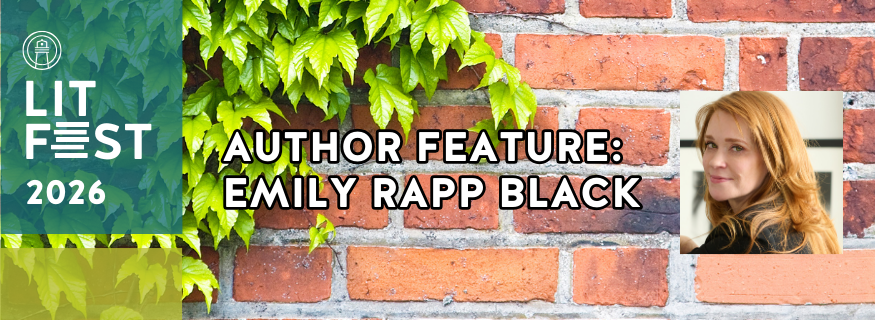
Emily Rapp Black is the author of Sanctuary and The Still Point of the Turning World. As well as receiving education from Harvard University, Trinity College, University of Texas at Austin, and St. Olaf College, she’s received the Fulbright Fellowship, the James A. Michener Fellowship, as well as the Rona Jaffe Foundation Writers’ Award. Black has traveled around the world for work.
Emily Rapp Black is teaching an advanced workshop at Lit Fest in 2026, Mapping the Memoir.
Learn a little about her in this Q&A before applying for her workshop.
How did you get interested in writing?
I’ve always been a big reader, and because I spent so much of my early life in the hospital, and we didn't have streaming services, just two bad soap operas to watch on a crummy TV in the middle of the day, I read a LOT. It was an escape and it was also a way of going inward and discovering that inner life is both refuge and inspiration, respite and challenge
What’s your teaching style? What can people expect in your workshops?
My teaching style is energetic, interactive, and intellectually rigorous. I have a lot of "methods" that I like to use in order to break down craft issues. I like to treat all written work as a living thing, a work literally in progress, and it's exciting to me when people engage with work in that way. I'm also opposed to the notion of "getting it right." That's not the goal– the goal is to enjoy the labor, feel alive as an artist, and deepen the work to the next level.
What's the best advice you ever got about writing?
Don't do it in order to be loved. Of course, I did just that, but guess what? It doesn't work. So don't do what I did.
If you could only bring three books with you on a deserted island, which ones would you choose, and why?
War and Peace, Frankenstein, and the Tibetan Book of the Dead. I love a 19th-century novel in all its messiness and sprawl, and the lessons from all of those novels are still relevant today. Also, on a deserted island, I would most certainly be eaten or die because I can't cook or forage for food, so I'd like to be prepared.
Why do you think the literary arts are important?
Art is what makes us human. Full stop. It's a conversation we have about being human across time, history, and culture. It's time travel. It's heart opening. It's the only thing that lasts.
In your memoirs, how do you decide what emotional truth belongs on the page and what remains private?
As someone who has never had any privacy, memoir is my privacy firewall. I can curate difficult experiences, which means I can protect myself in the telling– what is told and what remains untold.
LitFest is an annual celebration of readers and writers that turns Denver into a literary hub every June for a Colorado summer full of workshops, readings, events, and more!