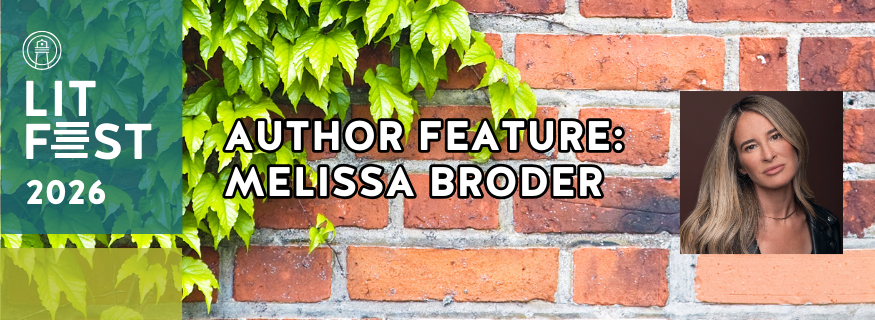
Melissa Broder is the author of several novels, essays, and poetry collections. Her novel Death Valley was called "incandescent...hilarious...a triumph" and named a Best Book of the Year by The New York Times, and Milk Fed was also named a Best Book of the Year by Entertainment Weekly, Vogue, and Time, among others. Broder received her BA from Tufts University and her MFA from City College of New York.
Melissa Broder is teaching an advanced workshop at Lit Fest in 2026, Using Image, which will explore the vibrant intersection of visual art and the written word.
Learn a little about her in this Q&A before applying for her workshop.
How did you get interested in writing?
I started writing poetry in the third grade and received positive feedback. So I kept doing it. I had this wonderful teacher, Mrs. Hovey, whom I always thank in the acknowledgements of my books. Mrs. Hovey could tell that I was a sensitive kid, and she kept encouraging me to write.
What’s your teaching style? What can people expect in workshops?
My workshops are eclectic, experimental, playful, and fun, and will include explorations of meditation, visual art, music, archetype, and myth as tools for literary creation.
What's the best advice you ever got about writing?
Read. A lot.
If you could only bring three books with you on a deserted island, which ones would you choose, and why?
I can't choose three books, but I can choose three authors: Marguerite Duras, Thomas Bernhard, and Clarice Lispector. They are my favorites.
Your work mixes the prosaic and the surreal. How do you decide when to introduce the uncanny?
It depends on the novel. In the case of Death Valley, I began writing the novel while my father was in the ICU for six months following a car accident. This was during COVID, and I wasn't able to go back to the East Coast and see him. I was experiencing anticipatory grief, though I didn’t know what that was at the time. I was trying to escape this feeling—driving back and forth through the desert between my home in L.A. and my sister's in Las Vegas. I was driving through Baker, CA, home of the world's largest thermometer, when an image came to me: a magic cactus where a protagonist, going through a similar grief journey, could go inside and encounter her father at various stages of his life. Cacti are rugged, hearty, tough. I longed to be a cactus at that time. Also, grief is a desert, in that we are as powerless over feelings as we are over nature. But there is beauty to be found in both: grief and the desert. Sometimes an archetype addresses reality more accurately than reality itself.
Why do you think the literary arts are important?
I think that question has as many answers as there are human beings who read. I can speak for myself and say that literature is a portal: sometimes a door out of reality, and sometimes a window into new perceptions of reality. And sometimes simply a question.
LitFest is an annual celebration of readers and writers that turns Denver into a literary hub every June for a Colorado summer full of workshops, readings, events, and more!