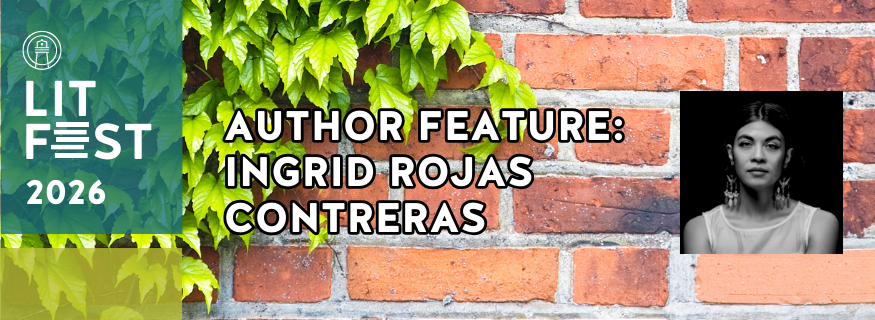
Ingrid Rojas Contreras is the award winning author of Fruit of the Drunken Tree and The Man Who Could Move Clouds. She holds an MFA from Columbia College Chicago and currently teaches fiction at the University of San Francisco. Contreras was born and raised in Bogotá, Colombia, but currently resides in California, where she has received numerous awards and fellowships from Bread Loaf Writer's Conference, VONA, Hedgebrook, The Camargo Foundation, and the National Association of Latino Arts and Culture.
Ingrid Rojas Contreras is teaching an advanced workshop at Lit Fest in 2026, Truth in Fiction.
Learn a little about her in this Q&A before applying for her workshop.
How did you get interested in writing?
I started writing the second I left Colombia with my family. We were fleeing kidnapping threats and landed in Venezuela. There was something about losing everything and exiling ourselves from our land, that made me turn to the page. I started writing in English then, and English became a private language of loss for me.
What’s your teaching style? What can people expect in your workshops?
Many workshops center around the audience and the audience’s reaction to a work, as if the piece was something that was already printed and had gone through an editorial process, but considering workshop pieces are in process, I like to run workshops that are author-vision led. I ask of myself and of the participants that we de-center ourselves (our story and style preferences, our taste) and center instead the dreams the author had for the piece. What literary lineage does the piece want to join? Who is the intended audience? What artistic risks did the author take? I think of a workshop as a laboratory, where participants, and myself as the leader of the workshop, are colluding with the author to help them achieve what they most desire for the work. From this position, we analyze the piece, look back on it, and talk about where, exactly, the piece is in line with the author’s intention, where it’s diverging, and what those diverging points might mean for what the piece itself seems to want to be.
What's the best advice you ever got about writing?
To put the work away and set it aside, as a strategy for defamiliarization in order to do the best edits!
Is there a benefit to working with other writers and having a writerly community?
Definitely! Capitalism might force the thought that every writer in the world is your competition, but I think this pollutes my desire to write, the reason why I do it. I don’t write to make money. Absolutely, I love being able to make a living out of writing, but that is not what drives me. I am an artist within a community of artists. Being an artist in a community of artists means we get the privilege of living an artist life—engaging with each other’s ideas, being excited, enthralled, and inspired by each other’s process and risk-taking, and being in conversation with work that is thousands of years old. Imagine how much richer your work can be when you think about it in this way, as something that fits and speaks back to and converses with a long lineage, rather than a means to an end.