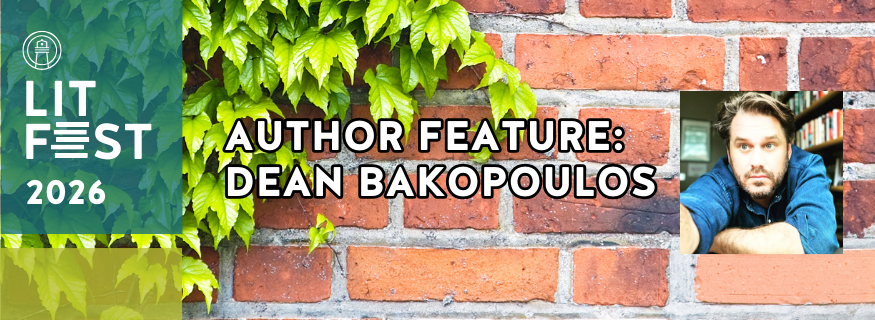
The winner of a Guggenheim Fellowship and NEA fellowships in both fiction and creative nonfiction, Dean Bakopoulos is an Associate Professor of cinema and head of screenwriting arts at University of Iowa. His first novel, Please Don’t Come Back from the Moon, was a New York Times Notable Book; he co-wrote and co-produced the film adaptation, which debuted at the Los Angeles Film Festival and was a New York Times Critics’ Pick. His second novel, My American Unhappiness, was named one of the year’s best novels by The Chicago Tribune, and his third novel, Summerlong, was an independent bookstore bestseller and is now in development as a television series.
Bakopoulos is teaching an advanced workshop at Lit Fest in 2026, Break The Story Free.
Learn a little about him in this Q&A before applying for his workshop.
How did you get interested in writing?
Growing up as a kid of immigrants—my mom is Ukrainian, my dad is Greek—I spent a lot of time hearing stories, songs, and scenes about people I’d never get to meet who lived in places I might never get to see. (I’ve now been to Greece a few times; my trip to Ukraine a few years back was postponed for obvious reasons.) Anyway, you develop an imagination at an early age that way and you also are infused with a sort of instinctive sense of a longing or exile, a yearning for a time or place you can’t get back to, except in art. It’s no wonder my sister Natalie and I both became novelists.
What’s your teaching style? What can people expect in your workshops?
I believe in giving people structural tools and elegant tricks in the workshops I teach in Lighthouse. I think folks can expect to learn ways to craft and revise stories (of any genre or form) with more dramatic momentum and emotional hooks. I’m fairly high energy and I like to think that I am funny. I will overshare, but eloquently. I am pretty blunt—I think we have to learn, as writers, how to manipulate our audiences into feeling feelings they might be afraid to feel. It’s an enormously fun challenge, and I love riffing on ideas.
What's the best advice you ever got about writing?
Wow. I’ve gotten so much great advice from so many great mentors and friends over the years, it’s hard to focus on just one piece as the best. My friend and former teacher Charles Baxter’s advice on request moments is pretty great, simple, and easy to apply. Whenever you get stuck in a story or scene, have one character say to another: There’s something I want you to do. Bam. Instant energy. Instant dilemma. Instantly interesting. He has an essay about this in his unbelievably wise book of essays, Wonderlands.
Why do you think the literary arts are important?
On the global level, they encourage the manufacturing of increasingly rare natural resources: empathy, imagination, ritual, and awe. On a more personal level, I’m working on a new book of nonfiction called The Creative Compulsion. It examines why some people—against all good sense—feel compelled to write stories and poems and essays. I think some people are born needing to write. I don’t mean to be overly mystical about it, but the drive to write is a spiritual one, essential to your nervous system and sanity if you have it, and if you ignore it, you get sad and you get sick. If you have the compulsion, this makes perfect sense. If you don’t, you’re lucky, but I also feel sorry for you.
You worked on a film adaptation of one story, and another is being made into a TV series. How do you shift your work for different media?
There are certain conventions in television writing, of course, but my approach usually starts with a character’s voice in my head, talking. Even for scripts. I have to let the character talk for a bit and then I find out the story. And so, I usually begin with prose, almost like I am taking dictation. Or I start talking into a voice recorder, channeling someone else. Eventually, I have to make a decision about the form, but most of my scripts probably begin as short stories, whether I finish them or not. One of the benchmarks of a great TV pilot—and I’ve sold five in the past five years, so I feel like I am figuring this out—is that you have to present a character that needs liberation from something so badly, that they’ll risk destruction to get it, that they’ll enter a new reality at the end of the pilot, a reality in which they can no longer deny their urge to get free.
Your novels balance humor, melancholy, and social observation. How do you decide what feeling should lead a scene and when the tone should shift?
I am naturally a little unhinged. I ride a roller coaster of emotions every day—goofy humor, weepy melancholy, political outrage, robust feelings of love and lust. My work just sort of happens that way. It’s very instinctive to me, these pivots. But I do think one of the greatest mistakes an emerging writer can make is a kind of sameness of tone. Tonal modulation is essential to the energy of any narrative or poem. It’s all gotta be in there, swirling underwater and fighting for the surface.