
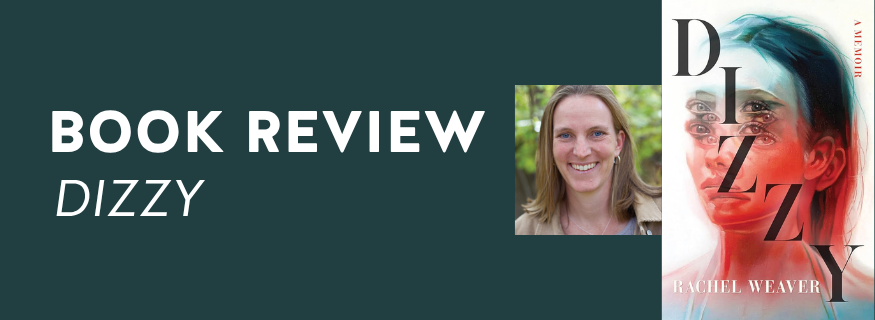
Rachel Weaver has long been a part of the Lighthouse community, taking on roles as a mentor in the Book Project and leading our Body of Words meetups. Her memoir DIZZY came out in February 2026 and focused on her decade-plus-long struggle with dizziness and navigating the healthcare industry. While the book has already received much praise, we're checking in with the Lighthouse community, who know Rachel well, to hear what they have to say about the memoir. Let's check in with Lighthouser Heather Campbell Grimes on her review of DIZZY.
Heather's Book Review
Rachel Weaver delivered her book, DIZZY, to my front door on the afternoon of my daughter’s tenth birthday, days before it was officially released. It took great restraint not to bow out of the cake and candles to hole up and immediately start reading.
I’ve had the privilege of calling Rachel a dear friend for over a decade now. She’s also one of my most cherished writing mentors; I trust her feedback as if it were unquestionable truth. She and her family happen to live a sling-shot away from our front yard with good aim. Her twin boys, a few years younger than my oldest, have grown up alongside my daughters. Our lives have overlapped and intertwined for most of motherhood.
And yet, there was so much I didn’t know.
In her memoir, DIZZY, Weaver brings us along on her decade-plus struggle with chronic dizziness and migraines, as she engaged with a medical system that seemed reluctant not only to listen, but to genuinely help at all. She draws parallels between her time spent in wild, irrepressible Alaska and weaves in the wisdom her father imbued before he died unexpectedly from a heart attack when she was a teen. But the book is truly about relentless hope, acceptance, and never, not ever, shying away from the life that is happening.
Rachel outwardly presents as a contradiction to even a mildly stereotypical “sick person.” I know her as a thoughtful, subtly hilarious, powerhouse of a woman. Her mind has a grand appetite for knowledge and stories. She is tough as nails and—since she has started feeling better—has no issue with kicking co-ed ass on the ice hockey rink. She works her ever-loving ass off at whatever she is committed to. I’ve only known that she struggled with ruthless dizziness, tormenting headaches, and grueling fatigue over the years because she told me, and not because she ever canceled plans or missed deadlines or called for backup with the kids.
And now, DIZZY shares this side of her story with the world.
One evening as I was reading DIZZY on the couch, my dog snoring at my feet, I had to put it down to experience a moment of raw feeling. It was as if a flood poured over the countless past experiences she and I have shared and everything was covered with a new sheen, essentially a much deeper knowing of her experience of life. When I was with her, I couldn’t see all of her. Of course I couldn’t, how could I for lack of setting up camp inside the walls of her mind?
Rachel’s writing is so juicy that from the moment I cracked open DIZZY, I wanted to do nothing else with my slender bits of uninhabited time. I gobbled up the prose without chewing. I stayed engaged because I was invested in her journey—step-by-step, month by month, year by year.
Everyone on the planet can relate to feeling powerless at certain times in life, only to find that those in the position of power are of zero help. And, what’s worse, they are not invested in sorting out how to learn what they don’t understand, or at least align as an ally to help investigate.
Rachel approaches life the way a kid approaches a cool, deep pond on a hot day—all in, cannonball. The motivation behind her some-may-say extreme approach to life can be sourced back to her father’s sudden death when he was barely middle-aged, after having lived a life that brimmed with often-dangerous adventure. He approached life like this:
Referring to the broken-down and smoking car he was driving home with his kids, “Better to expect this kind of shit…because it’s gonna happen. It always does. You learn to expect this, you’ll learn how to handle it, and you’ll be alright.” (pg. 26.)
She tackled living and healing in the same manner as the young woman who placed her whole body, mind, and instincts in the wilderness of Alaska. In a world of comfort-seekers and distraction junkies, Rachel is an anomaly in her relentless pursuit of wellness in the midst of feeling like hell. For nearly two decades, giving up was not an option for Rachel. Neither was slowing down.
The implications of the medical care system in DIZZY are pointed and unflinching, but Rachel is not out to villainize the doctors. Though most of them were deeply ungenerous with basic time and human care—this after she paid hundreds out-of-pocket and racked up credit card bills, and later had to pay a sitter to stay with her twins during appointments. Most were located in South Denver, so she drove the hour each way with one eye closed, and described the journey as harrowing at best. Some days were so bad she had to enlist the help of a friend to drive. Many docs then put her through torturous treatments and then put the onus on her when those treatments didn’t pan out. Even still, she was more than generous and sparing in her descriptions, save for a few gems.
"And besides, why do I trust the word of some guy who would undoubtedly get us killed in the backcountry if he was in charge out there?" (pg. 201.)
No, her tone is the opposite of someone who wants to come across as if they’d been done wrong. She is investigative, relentlessly curious. Her tone says, "HOW ON EARTH DID WE GET HERE, PEOPLE??" Nearly all of the close-to-forty medical professionals that she consulted were but cogs in a much larger—and very broken—medical system. And she refused to give up until she found someone with flesh and blood. And heart.
One may describe her choices in life as fearless, I would argue that she feels as much fear and discomfort as the rest of us. The difference is that she is not averse to looking fear directly in the eyes.
Not in the backwoods of Alaska, not in the office of yet another uncertain medical professional, not in her own mind. There were many weary days, days of considering avenues of escape, but she never stopped. Ever.
Alaska was rough, dangerous, and required all of her faculties to be on high alert. Home, as a wife and eventually a mother, required a different kind of vigilance and engagement. (One could argue it was not that different.) But the medical care system is the landscape that—try as unremittingly as she might—she could not make sense of.
"Maybe that cold, hard coast has been a training ground for the indifference of the US medical system." (pg. 188)
DIZZY speaks directly to a readership who has struggled with chronic illness and migraines, or those who are close to someone who has. But it is also a book that speaks to uneven power dynamics, how to find hope when it is scarce, how to keep living as you are, rather than as you wish you could be. I don’t know any among us who can’t relate.
DIZZY is also about character and will, about who Rachel is in accordance with what she is going through. She navigated the particularly shitty hand she was dealt based on how she was raised to live. This poses the question to the reader: Who would I be if in this situation? What would guide me?
I am certain that the feelings aroused while facing off a wild mama bear in Alaska are nothing to Rachel compared to the vulnerability that comes with offering her story like this. But what else is there to do with the most ravaged parts of our lives if not to shape them into their fullest expression of something meaningful to offer others? In a world where divisiveness is being cultivated by those at the very top, the selfless vulnerability Rachel tackled to hopefully be of benefit to someone else is a true act of civil disobedience. The world needs this book.
Memoir at its best makes you say, I hadn’t thought of it in that way, but now I cannot unthink it. And this is how systemic change happens. DIZZY does this.